MiniRobotLanguage (MRL)
BIT.Set - Set Bit to 1
Check if bit is set
Intention
Check if a specified Bit is set or cleared. Technically Bit.Set is somehow equal to an OR.
But more easy to use with Single Bits.
The parameters P1 and P2 can be given as value or as "binary".
Please see details on v/b here ! Smart Package Robot 's BIT. - Operations
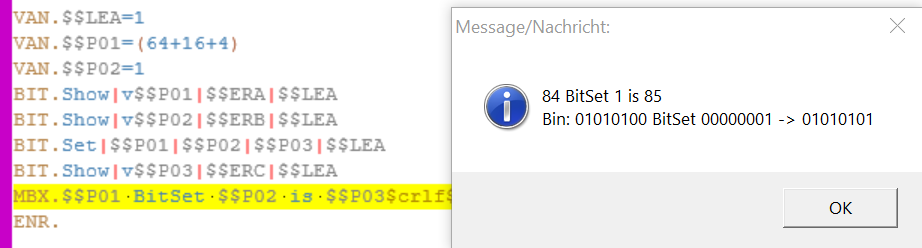
VAN.$$LEA=1
VAN.$$P01=(64+16+4)
VAN.$$P02=1
BIT.Show|v$$P01|$$ERA|$$LEA
BIT.Show|v$$P02|$$ERB|$$LEA
BIT.Set|$$P01|$$P02|$$P03|$$LEA
BIT.Show|v$$P03|$$ERC|$$LEA
MBX.$$P01 BitSet $$P02 is $$P03$crlf$Bin: $$ERA BitSet $$ERB -> $$ERC
ENR.
Syntax
BIT.Set|[b/v]P1|[b/v]P2|[b/v]P3[|P4]
Parameter Explanation
P1 - Variable containing a value or binary number. For example take the Number "9". It can be an ASC-Code "9" or the numeric number "9".
You can define this with a prefix of "v" for value and "b" for "binary". If the prefix is omitted, "v" is the default setting for P1.
P2 - Variable containing a value or binary number for the bit to set. Depending on P4 this number can be 1 to 8, 1 to 16 or 1 to 32. Unless "b" is prefixed the default type for P2 is "value".
P3 - Variable for result or "-". The result will always be numeric/value and can only be 1 or 0.
If omitted the result is placed on the TOS. Also here you can specify [b/v] for the format of the result. If you do not specify anything the result is "value"-Format.
P4 - optional, can be 1,2 or 4. Number of Bytes that are used internally. The number of Bits is the number of Bytes times 8.
1 - 8 Bits
2 - 16 Bits
4 - 32 Bits
Do not use the "8" Option. See Limitations below.
Example
'*****************************************************
' EXAMPLE 1:
'*****************************************************
VAN.$$LEA=1
VAN.$$P01=(64+16+4)
VAN.$$P02=1
BIT.Show|v$$P01|$$ERA|$$LEA
BIT.Show|v$$P02|$$ERB|$$LEA
BIT.Set|$$P01|$$P02|$$P03|$$LEA
BIT.Show|v$$P03|$$ERC|$$LEA
MBX.$$P01 BitSet $$P02 is $$P03$crlf$Bin: $$ERA BitSet $$ERB -> $$ERC
ENR.
Remarks
-
Limitations:
When using the "|8" Parameter, the lower 4 bits are possibly wrong. This is not a bug its due to the way variables are stored internally.
Therefore we recommend to not use this option.
See also:
See also:
•3.5 Hexadezimal, Decimal and Binary and more
•VTH. - Variable to Hexadecimal
•CAL. - mathematical CALculation
•VAR. - Variable Set Value/Clear
•! Smart Package Robot 's BIT. - Operations
•BIT.16to8 - Split 1 Word into 2 Bytes
•BIT.16to32 - concatenate 2 Words to 32 Bit DWord
•BIT.32to16 - Split 1 DWord into 2 Words
•BIT.8to16 - concatenate 2 Bytes to 16 Bit Word
•BIT.AND - Use logical AND with Bits
•BIT.LShift - Shift Bits to Left, insert 0
•BIT.NOT - Use logical NOT with Bits
•BIT.OR - Use logical OR with Bits
•BIT.RotateLeft - Rotate Bits Left
•BIT.RotateRight - Rotate Bits Right
•BIT.RShift - Shift Bits to Right, insert 0
•BIT.Show - Show Bits in Binary-Numbers
•BIT.Store - Set Bit to 1 or 0
•BIT.ToBin - change Parameter to Binary-Format
•BIT.ToVal - change Parameter to Value-Format
•BIT.XOR - Use logical XOR with Bits
•BIT.Get - check if Bit is set
• CAL. - mathematical CALculation
• VAR. - Variable Set Value/Clear